Written Session: High Ball 2-4 GK #1

The opposition midfielder carries the ball towards the defensive line and plays to the winger. The winger draws in the full-back. The midfielder makes an overlapping run. The winger either delivers the ball into the penalty area himself or plays the overlapping teammate in. The overlapping player then delivers a high ball above waist height into the penalty area. The attackers are ready to finish.
Focus
Orientation & Technique
Content
Tactics
The goalkeeper positions himself in relation to the ball and the opposition players.
He adjusts his body shape according to the distance and situation.
Technique
The goalkeeper deals with High Ball situations using the appropriate catching or diving technique.
Objectives
The goalkeeper develops a solid foundation in positioning and technique. He deals with game situations efficiently and safely.
Organisation & Equipment
• 3 goalkeepers (GK)
• 1 Goalkeeper Coach (GC)
• 1 goal
• approx. 10 balls
• If available: 1–2 Brix, 1 Sniper
CONNECT
Sequence
• 2–3 rounds per GK, followed by a change of sides
• Slightly vary the starting position (PO1) each time
Start
• GK Yellow starts in the starting position (PO1), positioned towards GC.
Action 1
• GC plays the ball as a back pass, low ball, bouncing ball or as preparation for a high ball.
• GK Yellow handles the ball and remains in PO1.
Action 2
• Signal from GC.
• GK Yellow positions himself towards GC 1 and shifts into PO2.
• GC 1 plays the ball as a back pass, low ball, bouncing ball or as preparation for a high ball.
• GK Yellow handles the ball and remains in PO2.
Action 3
• Signal from GC 1.
• GK Yellow positions himself towards GK Red.
• GK Red plays the ball as a back pass, low ball, bouncing ball or mid-height ball.
• GK Yellow handles the ball and shifts back into PO2.
Action 4
• Signal from GC 1.
• GK Yellow positions himself towards GK Blue.
• GK Blue plays the ball as a back pass, low ball, bouncing ball or mid-height ball.
• GK Yellow handles the ball.
→ Round finished.
After each round, the GKs change positions.
• During the position change, perform activation exercises such as arm circles, high knees, skipping or light mobility movements.
CONNECT+
After the Connect rounds, one additional round follows.
The basic organisation and sequence remain the same.
The following changes:
• GK Yellow starts seated in the starting position (PO1), positioned towards GK Blue.
• Action 1 consists of a ground familiarisation exercise such as 3-Corner, 2-Knee or 1-Knee, followed by a ball as preparation for a high ball.
• Actions 2 to 4 are performed as a low shot to dive.
→ Round finished.
Control
The coach (GC) controls the exercise with clear visual and verbal cues.
He varies the deliveries and adjusts the tempo and intensity accordingly.
LEARN
Sequence
• 2–3 rounds per GK, followed by a change of sides
• Slightly vary the starting position (PO1) each time.
Start
• GK Yellow starts in the starting position (PO1).
Action 1
• GC plays a pre-announced high ball to GK Yellow.
• GK Yellow handles the ball and remains in PO1.
Action 2
• Signal from GC.
• GK Yellow positions himself towards GC 1 and shifts into PO2.
• GC 1 plays a pre-announced high ball to GK Yellow.
• GK Yellow handles the ball and remains in PO2.
Action 3
• Signal from GC 1.
• GK Yellow positions himself towards GK Red.
• GK Red plays a pre-announced ball from the hands over the head, as a bouncing ball or as a mid-height ball to GK Yellow.
• Alternatively, the pre-announced delivery is played with the Sniper following a throw from GC 1.
• GK Yellow handles the ball.
• GK Yellow shifts back into PO2.
Action 4
• Signal from GC 1.
• GK Yellow positions himself towards GK Blue.
• GK Blue plays a pre-announced ball from the hands over the head, as a bouncing ball or as a mid-height ball to GK Yellow.
• Alternatively, the pre-announced delivery is played with the Sniper following a throw from GC 1.
• GK Yellow handles the ball.
→ Round finished.
After each round, the GKs change positions.
Note
All balls are announced in advance so that the GK knows the direction and type of delivery.
Control
The coach controls the exercise with clear visual and verbal cues. He varies the types of delivery and adjusts the tempo and intensity accordingly.
EVOLVE
Sequence
• 3 rounds per GK, then change positions
• Each GK completes 3–5 sets of 3 rounds
• Followed by a change of sides
Start
• GK Yellow starts in the starting position (PO1) and positions himself towards GC.
Action
• GC carries the ball.
• GC delivers an inswinging or outswinging cross into the penalty area.
• Alternatively, GC carries the ball into a deeper position and crosses from there.
• GK Blue and GK Red make runs into the penalty area and look to finish.
• GK Yellow reads the rhythm of the action and the ball.
• GK Yellow adjusts his position accordingly.
• GK Yellow makes a situational decision based on the available references.
• GK Yellow applies the most effective save technique.
→ Round finished.
Variations
• Undeclared: GK Yellow knows neither the direction nor the type of delivery.
• Semi-declared: The direction is known, but the height or trajectory is not.
• Vary the runs: Adjust the position and timing of GC, GK Blue and GK Red.
• Additional defender: One GK takes on the role of a defender for greater realism and communication.
APPLY
Sequence
• At least 8 outfield players + GK
• 3 rounds per GK, then change positions
• Each GK completes 3–5 sets of 3 rounds
• Adjust the number of rounds and sets depending on the time available.
• Followed by a change of sides
Game Format: 5v3 plus GK
• GK Yellow starts in the starting position and positions himself according to the attacking action of Team Red.
• Team Blue defends the penalty area together with GK Yellow according to the team’s defensive principles.
• The defensive line starts just inside the penalty area.
• A Team Red midfielder plays the ball out wide.
• The winger draws in the full-back.
• The winger either delivers the ball directly into the penalty area or lays it off to a supporting teammate.
• The supporting teammate then delivers the ball into the penalty area.
• The Team Red players make active runs into the penalty area.
• GK Yellow reads the play and makes a situational decision.
→ Round finished.
Variations
• Starting point of the attack: Vary the trigger for the attack.
• Runs and passing patterns: Adjust the positions of the outfield players and the speed of play.
• Numerical advantage / disadvantage: Create attacking or defensive overload situations depending on the training objective.
NORMALIZE
Objective
Recovery after intense training loads or matches.
Formats
Active recovery, stretching, mobility, loosening exercises, breathing exercises and playful activities.
Focus
Mental and physical recovery.
Mental relaxation and restoration of movement quality.
Integration
At the end of the training session or as a standalone recovery block.
Duration: 5–10 minutes.
Note
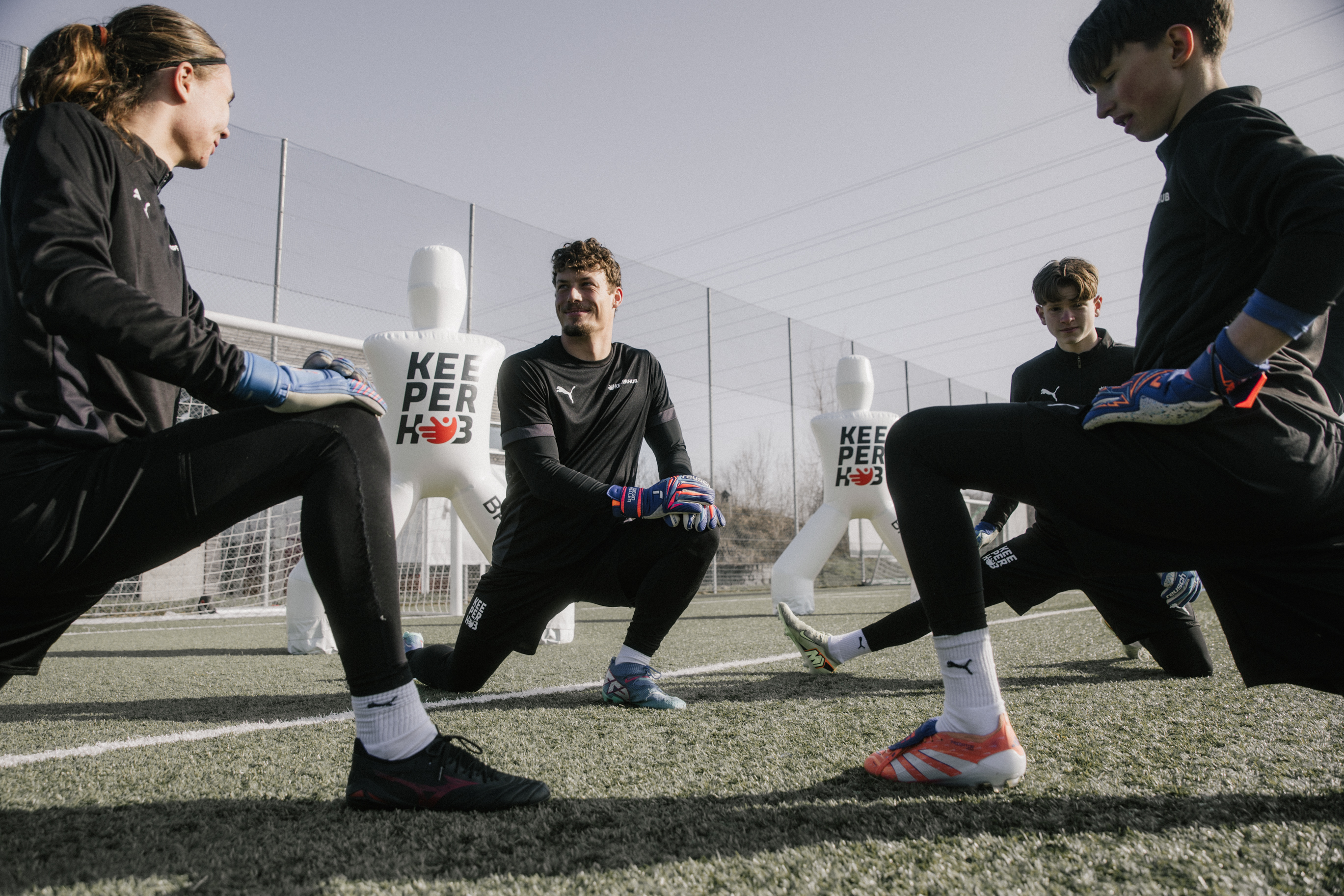
You can find further ideas and specific exercise suggestions in our blog.