Written Session: Through Ball 1 GK #2
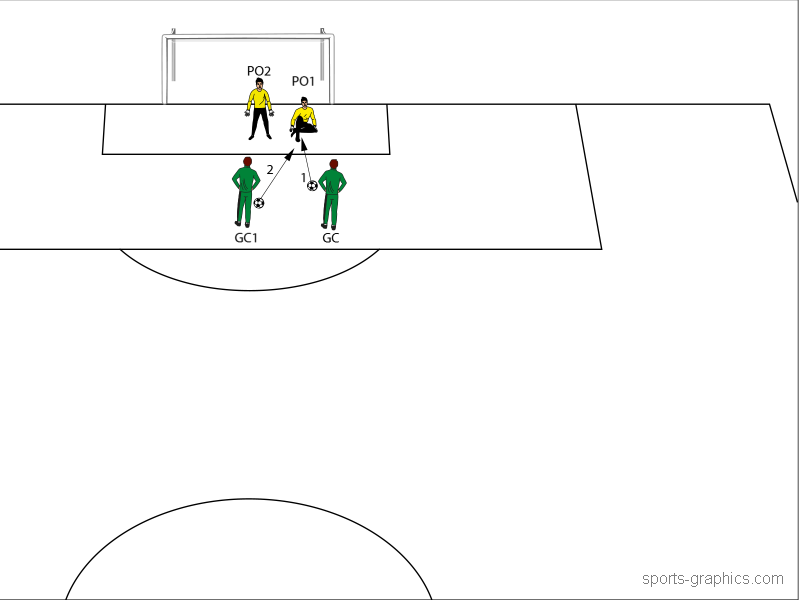
The opposition number 8 plays a vertical pass to the number 10. The number 10 plays a through ball in behind. The winger sprints in behind the defensive line. He either goes into a 1v1 with the goalkeeper or finishes directly. The through ball is played variably between the right centre-back and full-back, between the centre-backs or down the left side.
Focus
Orientation & Technique
Content
Tactics
The goalkeeper positions himself in relation to the ball and the opposition players.
He adjusts his body shape according to the distance and situation.
Technique
The goalkeeper deals with Through Ball situations using secure catching, diving or 1v1 techniques.
Objectives
The goalkeeper develops a solid foundation in positioning and technique. He deals with game situations efficiently and safely.
Organisation & Equipment
• 1 goalkeeper (GK)
• 1 Goalkeeper Coach (GC)
• 1 goal
• approx. 10 balls
CONNECT
Sequence
• 2–3 rounds, followed by a change of sides
Start
• GK Yellow starts in the starting position (PO1).
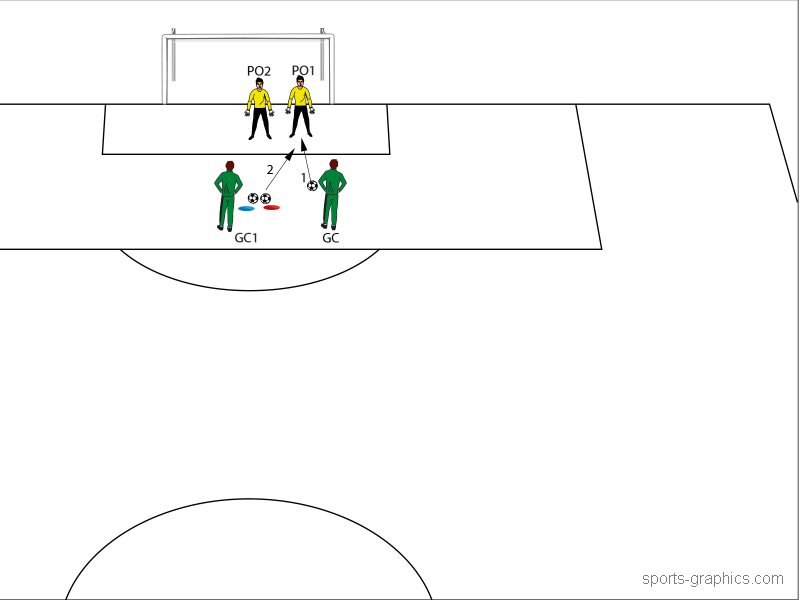
Action 1
• GC plays the ball to GK Yellow as a back pass, low ball, bouncing ball or mid-height ball.
• GK Yellow handles the ball.
• GK Yellow remains in position PO1 and positions himself towards GC.
Action 2
• GC moves into position GC1.
• Signal from GC1: the right arm is pulled down.
• GK Yellow positions himself towards GC1 and shifts into position PO2.
• GC1 plays the ball into space towards GK Yellow as a back pass, low ball, bouncing ball or mid-height ball.
• GK Yellow reacts actively and handles the ball.
→ Round finished.
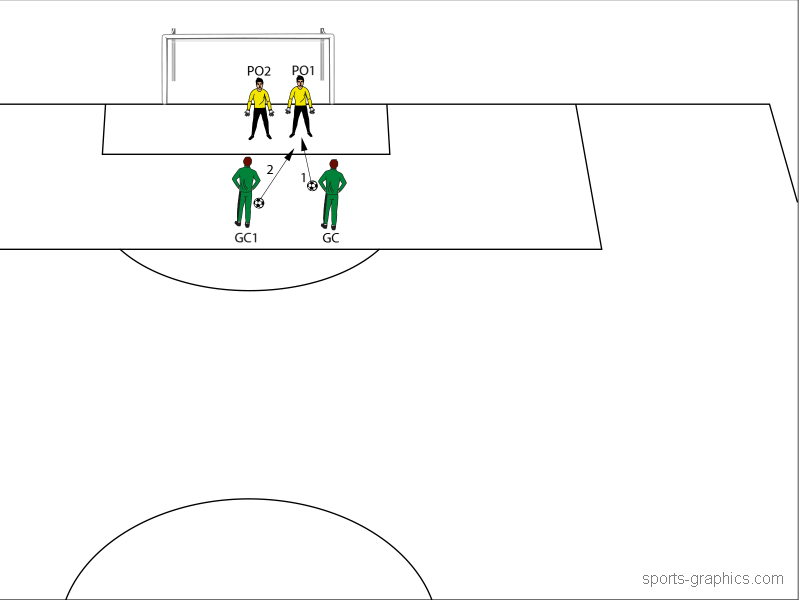
CONNECT+
After the regular Connect rounds, one additional round follows.
The basic organisation and sequence remain the same.
The following changes:
• GK Yellow starts seated in the starting position (PO1).
• Action 1 consists of a ground familiarisation exercise such as 3-Corner, 2-Knee or 1-Knee.
• Action 2 is performed as a low shot to dive or as preparation for 1v1s.
→ Round finished.
Control
The coach (GC) controls the exercise with clear visual and verbal cues.
He varies the deliveries and adjusts the tempo and intensity accordingly.
LEARN
Sequence
• 2–3 rounds, followed by a change of sides
Start
• GK Yellow starts in the starting position (PO1).
Action 1
• GC plays Ball 1.
• GK Yellow handles the ball.
• GK Yellow remains in position PO1 and positions himself towards GC.
Action 2
• GC moves into position GC1.
• Signal from GC1: the right arm is pulled down.
• GK Yellow positions himself towards GC1 and shifts into position PO2.
• GC1 plays either:
• Ball Blue as an attack on the ball with a dive.
• Ball Red as a 1v1 using a small block or big block.
• GK Yellow reacts actively and handles the ball.
→ Round finished.
Note
All balls are announced in advance so that the GK knows the direction and type of delivery.
Control
The coach controls the exercise with clear visual and verbal cues.
He varies the deliveries and adjusts the tempo and intensity accordingly.
EVOLVE
Sequence
• 3–5 rounds, followed by a change of sides
Start
• GK Yellow starts in the starting position (PO1).
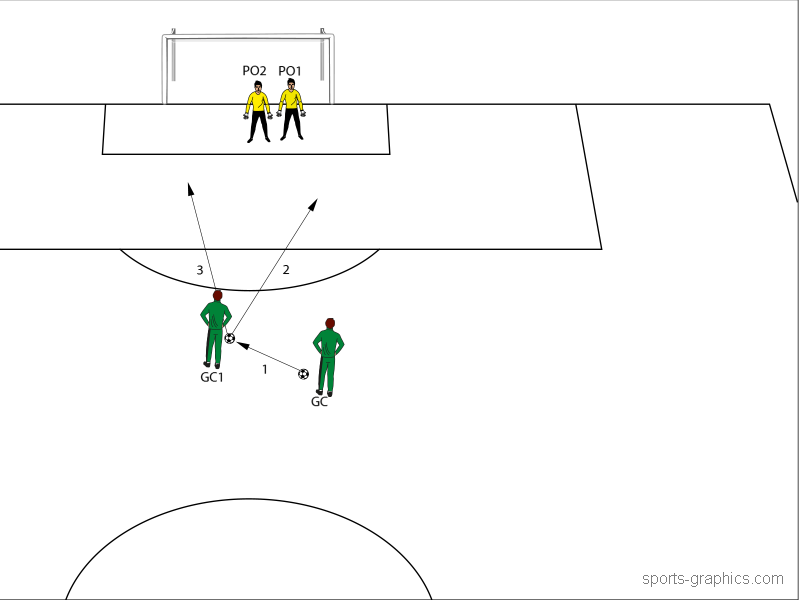
Action 1
• GC moves into position GC1 and plays Ball 2 or Ball 3 in behind.
• Depending on the pace of the ball, GC1 can follow the pass to create a potential 1v1.
• GK Yellow reads the through ball, makes a situational decision and attacks the ball or goes into a 1v1.
→ Round finished.
Variations
• Undeclared: GK knows neither the direction nor the type of delivery.
• Semi-declared: GK knows where the ball will be played, but not the trajectory or pace.
• Vary the runs: Adjust the position and timing of GC and GC1.
APPLY
Sequence
• At least 7 outfield players + 2–3 GKs
• 3 rounds per GK, then the GKs change positions
• Each GK completes 3–5 sets of 3 rounds
• Adjust the number of rounds and sets depending on the time available
• Followed by a change of sides
Game Format: 4v2 or 4v3
• GK Yellow starts in the starting position (PO1) and positions himself according to the attack of Team Red.
• Team Blue defends the penalty area together with GK Yellow according to the team’s defensive principles.
• The defensive line plays high and positions itself outside the penalty area.
• Team Red plays the ball into midfield.
• The centre-back is drawn out.
• A through ball is played in behind.
• Both wingers make runs in behind, attack the penalty area and look to finish.
• GK Yellow reads the play and makes a situational decision.
→ Round finished.
Variations
• Starting point of the attack: Vary the trigger for the attack.
• Runs and passing patterns: Adjust the positions of the outfield players and the speed of play.
• Numerical advantage / disadvantage: Create attacking or defensive overload situations depending on the training objective.
NORMALIZE
Objective
Recovery after intense training loads or matches.
Formats
Active recovery, stretching, mobility, loosening exercises, breathing exercises and playful activities.
Focus
Mental and physical recovery.
Mental relaxation and restoration of movement quality.
Integration
At the end of the training session or as a standalone recovery block.
Duration: 5–10 minutes.
Note
You can find further ideas and specific exercise suggestions in our blog or video.