


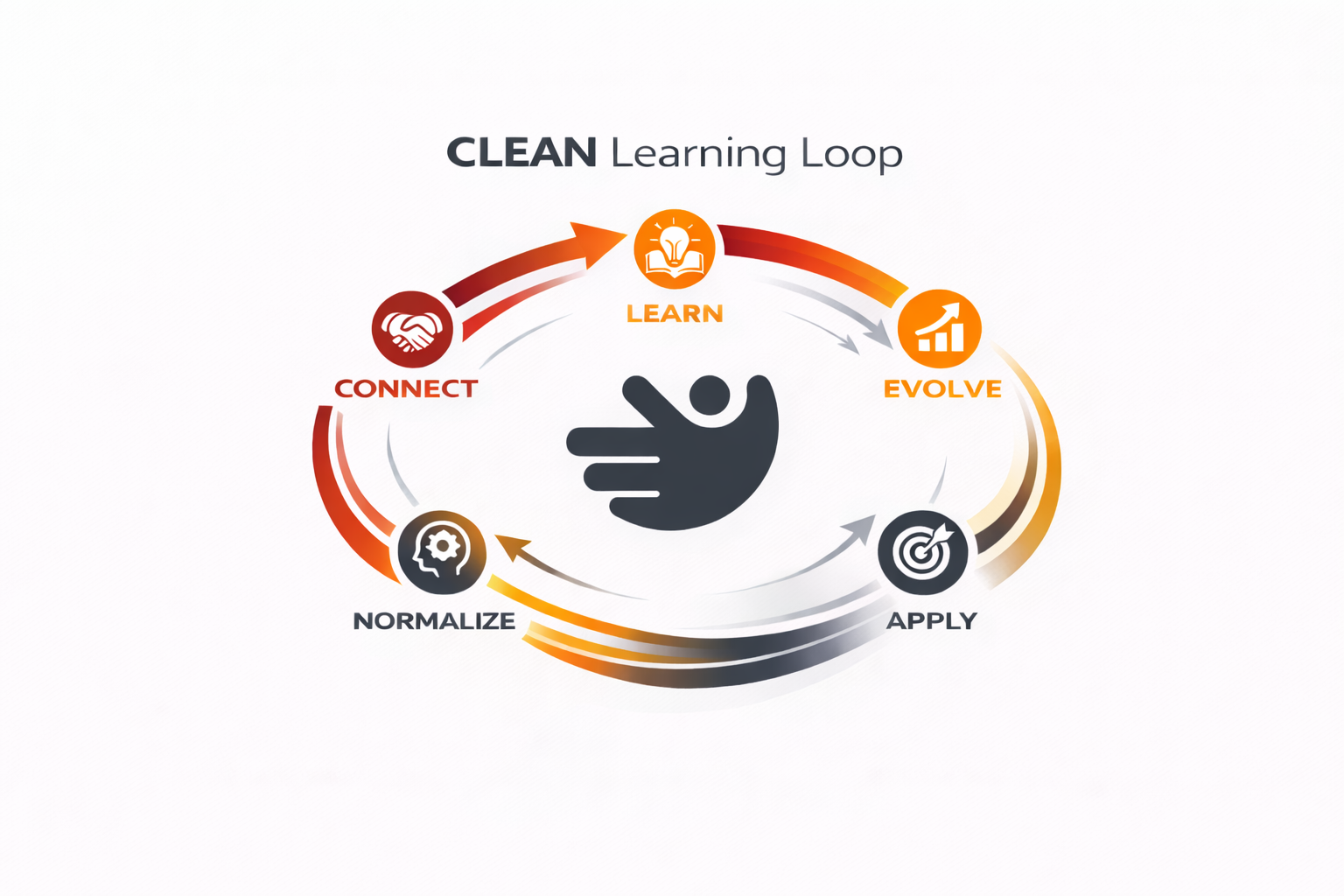
The CLEAN method provides the framework for our goalkeeper training. It is not a collection of drills, but a tool to plan and structure training in a clear and focused way. CLEAN helps you base your sessions on game situations and connect your content in a logical way.
The problem in everyday training
Many goalkeeper coaches plan their sessions the evening before or only a few hours in advance. They use exercises they know from the internet or from their own experience. This often leads to training sessions that are varied, but lack structure. For example, a session might start with a passing drill, followed by diving actions, then high balls, and finish with close-range shots. Many different aspects are included, but none are developed in a focused way. The session contains content, but it does not build step by step. At the same time, many exercises are isolated and have little connection to the game. In our view, goalkeepers need to be prepared for the situations they face repeatedly in matches.
Structure as the foundation
This is where a clear structure becomes essential. Content builds on each other and gives the training a clear direction. The session becomes structured, understandable and purposeful. Based on this idea, we developed CLEAN – a model that structures goalkeeper training and consistently starts from the game. CLEAN stands for five connected phases: Connect, Learn, Evolve, Apply and Normalize. The graphic below shows how these phases are linked within a training session.
CLEAN in practice: Game situation Low Cross
Now we want to show what CLEAN looks like in practice. As an example, we use the game situation Low Cross. It is one of the most common situations in modern football and places high demands on positioning, perception, technique and coordination with the defenders.
Understanding the game situation
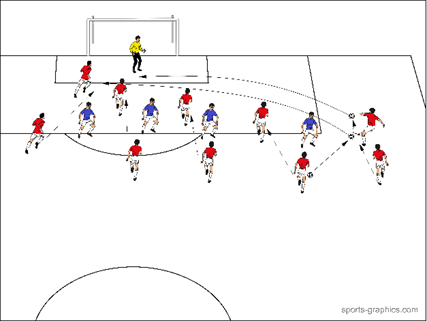
In a Low Cross situation, the opponent switches play from the centre to the wing. The winger engages the full-back (FB) and plays a low ball across the penalty area towards attacking players. For the goalkeeper, this creates a dynamic situation with several demands:
- switch of play from the centre to the wing
- high running speed of the attackers
- low crosses through the penalty area
- finishes from short distance
Define the focus
The focus of this session is basic positioning and technique.
The key points are:
- orientation towards the ball and the opponents
- adapted body position depending on distance and situation
- correct decision between defending space and defending the goal
- secure technical solutions in catching, diving and duels
The aim is for the goalkeeper to build a stable base in positioning and technique in order to deal effectively with low crosses and finishes inside the penalty area.
Core principle: movement logic stays the same
Independent of the CLEAN phase, the movement logic remains the same. Already in the planning phase, it is defined:
- in which starting position the goalkeeper begins the action
- how the goalkeeper moves within the game situation
- in which end position the goalkeeper is before the final action
The goalkeeper starts in a stable basic position and orients towards the ball, the attackers and the defensive line. As the play shifts to the wing, the goalkeeper moves in a controlled way and adjusts distance and angle. Before the low cross, the goalkeeper is in a clearly defined end position, from which the final movement is executed. Important: the rhythm of the action matches the game. A disguised pass must simulate the real timing of the ball. The finish does not happen immediately, but with the delay the ball would have in the game. This allows the goalkeeper to move in a game-realistic way and react to the situation in the rhythm of the ball. This sequence remains the same across all CLEAN phases. What changes are the type of service, tempo, intensity and decision-making pressure.
Implementation within the CLEAN phases
Connect
The session starts with a short block of stabilisation and mobility. After that, the goalkeeper is already working within the structure of the game situation. In the Connect phase, the body is activated and prepared for the movement logic. Simple catching and footwork exercises are the focus. The goalkeeper stays within the defined structure. Starting position, movement and end position are clearly set and consistently applied. If needed, coordinative, cognitive and physical stimuli can be integrated. The goalkeeper orients in space and in the goal and is prepared for the game situation from the beginning, with low intensity.
Connect+
Connect+ is the transition into the main part of the session and is part of the Connect phase. It is a single repetition that directly follows Connect. In this repetition, specific elements are prepared that will be developed in the following phases. Often, this includes ground work or preparation for duel situations. The structure remains the same. The goalkeeper continues to move within the defined movement logic.
Learn
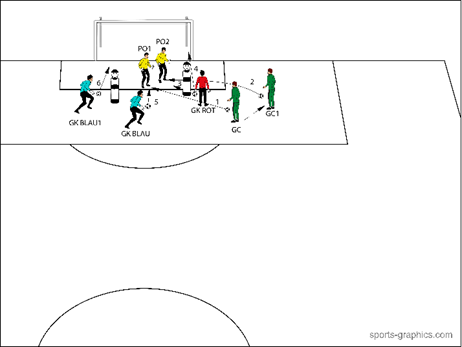
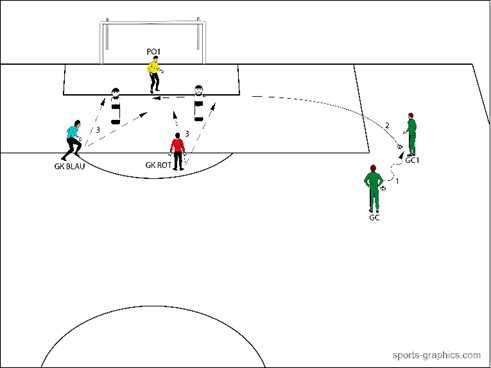
In this phase, technical execution and behaviour are developed in a targeted way. The focus is on the connection between technique, perception and decision-making. The situations are game-related and build on the movement patterns defined in the Connect phase. The finishes are predetermined. This means it is clear where the ball is played and which technique the goalkeeper uses to deal with it. This allows the goalkeeper to focus on execution and behaviour. The goalkeeper repeats the actions and stabilises technical and tactical execution. In this way, different solutions for the game situation are developed, which the goalkeeper can later use.
Evolve
In this phase, the complexity of the situation increases. The type of service, runs and finishes become more variable and are no longer predetermined. The goalkeeper has to react to different situations and make their own decisions. The focus is on perception and decision-making at higher speed and under increasing pressure. The movement logic remains the same. The goalkeeper uses the solutions developed in the previous phases and adapts them to the situation.
Apply
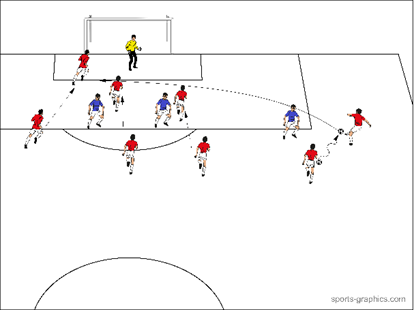
In this phase, the game situation is transferred into team training. Low crosses come from real attacking situations with teammates and opponents. The goalkeeper deals with the situation together with the defence. The content from the previous phases is applied under game conditions and connected with the team. Already in the planning, exercises and game formats are designed to have a clear link to the game situation. The coach guides the situation through targeted coaching and supports both the goalkeeper and the outfield players. This allows the goalkeeper to develop not only individually, but also in connection with the team.
Normalize
At the end of the session, a recovery phase follows. The body is brought down and the training is consciously completed. Ideas and concrete examples for designing the Normalize phase are shown in a separate article.
Conclusion
CLEAN helps you structure and plan your goalkeeper training in a clear and focused way. The method gives you a framework without dictating specific content. You plan your session based on game situations, define a clear focus and organise the flow in a game-related way. This creates training that is understandable and builds step by step.